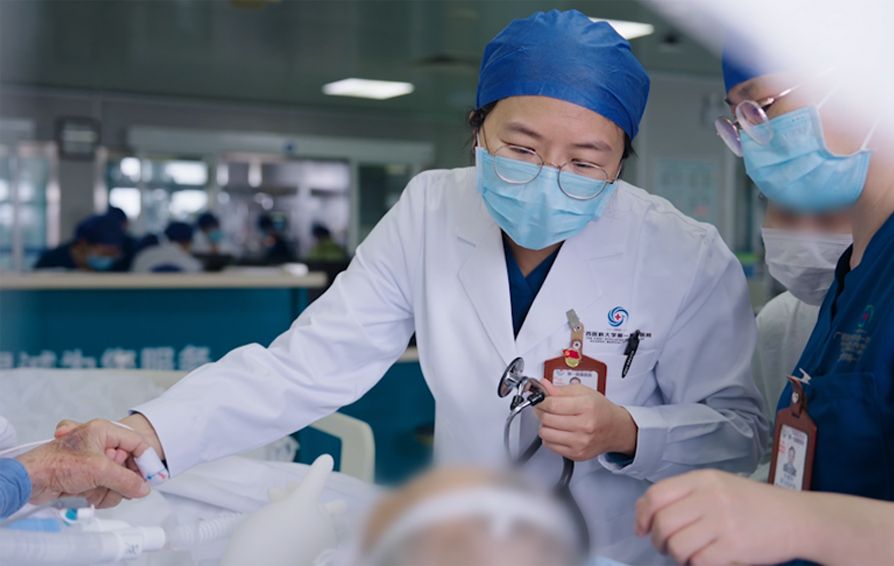
The ICU is often referred to as the threshold between life and death.
Every day, we need to bring patients back from the brink of death.
It’s not just about saving a patient, but about saving a family.
The ICU is often where life comes closest to death in a hospital. For
the medical team in the Department of Critical Care Medicine at the
First Affiliated Hospital of Guangxi Medical University, it is not only
where they save critically ill patients, but also where they face
uncertainties. Every clinical decision they make and every intervention
they perform carry the hope of an entire family.
As a key force in regional critical care, the Department of
Critical Care Medicine at the First Affiliated Hospital of Guangxi
Medical University has constantly been probing: faced with vast
and complex clinical information, how can they identify the risk
of deterioration earlier? How can they make clinical decisions
more precisely? How can they achieve more efficient teamwork among
medical staff? Ultimately, they can dedicate more time and energy
to what matters the most: saving lives.
Based on this, the department collaborated with Mindray to promote
the deployment of the M Connect ICU Solution in core clinical
scenarios of critical care, exploring an innovative path for high
quality disciplinary development that is grounded in information
technology and driven by digital intelligence.
Turn disorganized data into a basis for clinical decisions Make complex conditions clear and understandable
Zhaoyan Chen
Deputy Director of Ward 1, Department of Critical Care
Medicine The First Affiliated Hospital of Guangxi Medical
University
Data from critically ill patients is massive and disorganized.
The system organizes and structures the data, and identifies
trends, allowing us to comprehensively understand patients’
conditions in a short time and supporting subsequent diagnostic
and treatment decisions.
There is never a scarcity of data in the ICU. What is scarce is
information that can be quickly extracted, summarized, and used to
support clinical decisions.
In the past, to comprehensively understand patients’ conditions, medical
staff had to manually record large amounts of physiological data, such
as fluid intake and output, infection markers, temperature changes, and
vital signs, and then categorize, aggregate, plot the data to analyze
trends. This consumed a great deal of time and labor while lacking
continuity and accuracy.
Today, the most direct change brought by the system is the integration
of multidimensional, multimodal information-originally scattered across
different devices, records, and moments-into a comprehensive digital
twin of the patient.
The information is presented in modules according to clinical
priorities, providing strong support for medical staff to quickly and
fully understand the patient’s condition and formulate subsequent
treatment plans. It also makes it possible for them to devote more time
and energy to analyzing and managing complex clinical cases.
Liangyan Jiang
Associate Chief Physician of Ward 2 Department of Critical
Care Medicine
The First Affiliated Hospital of Guangxi Medical University
A young post organ transplant patient left a deep impression
on me. Due to the use of immunosuppressants, the patient
developed viral, fungal, and multidrug resistant bacterial
infections, with recurrent worsening of the condition and
even cardiac arrest.
The treatment of such patients is extremely complicated.
Infections, circulation, respiration, and renal dysfunction
are interwoven and influence each other.
Therefore, we must continuously and dynamically adjust
treatment strategies based on changes in the patient’s
condition, including fluid management, the intensity of
organ support, trends in clinical parameters, and the timing
of weaning.
During treatment, the system allows us to clearly and
comprehensively grasp the multidimensional changes in
patients’ parameters, and accurately track urine output,
fluid balance, and organ function scores. This lays the
foundation for us to quickly reach a consistent judgment
during handovers, ward rounds, and emergency care.
From reactive detection to proactive warning Make
risk changes visible earlier
“There are no sudden changes in patients’ conditions but only sudden
detection of those changes.” Juntao Hu, Deputy Director of Ward 2 at the
Department of Critical Care Medicine, believes that most critical
deteriorations do not occur without signs. A drop in blood pressure, an
increase in heart rate, respiratory abnormalities, fluctuations in
oxygenation...Behind these changes, there are often signs that could
have been detected in advance. Yet for clinicians, the greatest
challenge lies in dynamic assessment and timely recognition.
The value of the system lies in its continuous dynamic monitoring of
patients’ vital signs, intelligent identification of changes in their
conditions, early warning of deterioration risks, and its ability to
generate 24 hour clinical summaries along with recommendations for next
step diagnosis and treatment. This means that clinicians can detect
early signs of changes in patients’ conditions, seize the optimal window
for intervention, and take effective actions in advance.
At the same time, the system also acts as a bridge, closely connecting
different clinical roles, such as intensivists and nurses, to form an
efficient closed loop of early warning, response, and collaboration,
thereby further improving the quality and efficiency of clinical care
and patient outcomes.
Zhaoyan Chen
Deputy Director of Ward 1
Department of Critical Care Medicine
The First Affiliated Hospital of Guangxi Medical University
Recently, we admitted an elderly patient with a history of
COPD who was receiving mechanical ventilation after surgery.
During the process, the system indicated a drop in oxygen
saturation and a significant increase in heart rate, and the
nurse promptly notified the clinician.
The clinician came to the bedside, performed a physical
examination, and found significantly diminished breath
sounds on the right side. Based on the patient’s medical
history as well as the clinical summary and treatment
recommendations provided by the system, we suspected a
tension pneumothorax.
A diagnostic puncture was immediately performed, and the air
was withdrawn. After that, we contacted the Radiology
Department for a bedside chest X ray, which confirmed our
diagnosis and intervention.
Subsequently, as we continued to aspirate the air to relieve
the tension pneumothorax, we contacted the Thoracic Surgery
Department to perform a chest tube insertion. The nursing
team assisted with fluid administration and other supportive
care. Throughout the whole process, the rapid response and
close collaboration among different departments and medical
staff led to a successful outcome for the patient.
From clinical application to department management Digital intelligence drives high quality development in
critical care
Juntao Hu
Deputy Director of Ward 2, Department of Critical Care
Medicine
The First Affiliated Hospital of Guangxi Medical University
Next, the department will continue to promote the integration of
big data and AI. Building on the existing system, this will
provide clinicians with more targeted and individualized
diagnosis and treatment plans, offering decision-making support
as a “second perspective” when they encounter complicated
situations.
In the future, with the ongoing implementation of the M Connect
ICU Solution and the QiYuan Critical Care Medicine LLM, the
department will further develop its database platform, driving
holistic improvements across multiple dimensions of clinical
practice, research, education, and talent development, thereby
contributing to high quality development of the discipline.
This digital intelligent transformation is developing a new approach for
the Department of Critical Care Medicine at the First Affiliated
Hospital of Guangxi Medical University to build a smart critical care
system.
At the “threshold between life and death”, the M Connect ICU Solution
and the QiYuan Critical Care Medicine LLM are driving the ICU towards a
more collaborative, more precise, and more compassionate “stronghold of
life”.
(function () {
console.log(11111);
});
false
{"enabled":true,"consentTitle":"We value your privacy","message":"This content is hosted by an external provider. Enabling it may allow the provider to process your personal data and set cookies.\r\n","acceptLabel":"Allow \u0026 Continue","alwaysAcceptLabel":"Always trust and apply default supplier settings.","consentState":"undecided"}