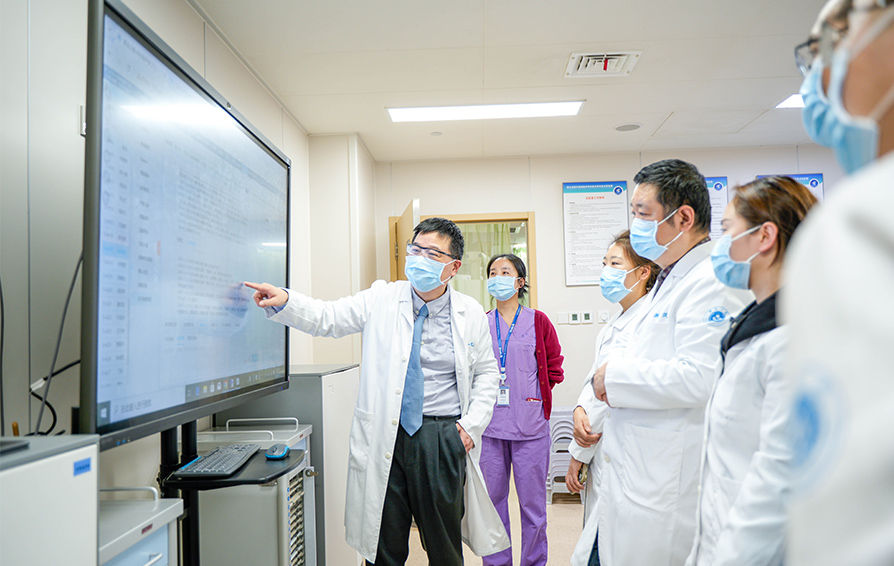
On March 15th, China Central Television (CCTV)'s Focus Interview aired an episode titled "Empowering Healthcare with AI," offering viewers an inside look at the ICU at the First Affiliated Hospital, Zhejiang University School of Medicine. The episode spotlights the Qiyuan Critical Care Model and M-Connect Critical Care Decision Support System, exploring how AI helps physicians make better decisions, improve workflow efficiency, and deliver standardized yet personalized critical care.
Piercing the Data Fog
Technology is advancing at an unprecedented pace, with AI transforming every aspect of our lives. At the ICU of the First Affiliated Hospital, Zhejiang University School of Medicine, a revolution is underway: digital twins and AI are quietly reshaping how medical staff deliver healthcare.
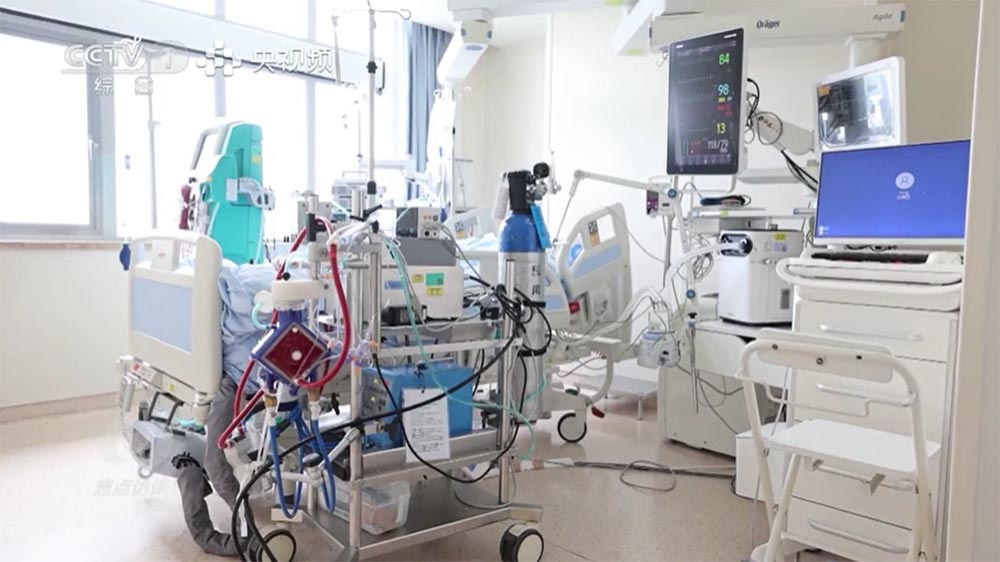
At the ICU, medical devices at each patient's bedside are constantly generating massive amounts of data.
Cai Hongliu
Director of the Intensive Care Unit, the First Affiliated Hospital, Zhejiang University School of Medicine
We used to use pen and paper to record changes in various parameters every single hour, which was essential for patient assessment. However, the sheer volume of data has become a pressing clinical challenge.
Digital Twin in the ICU
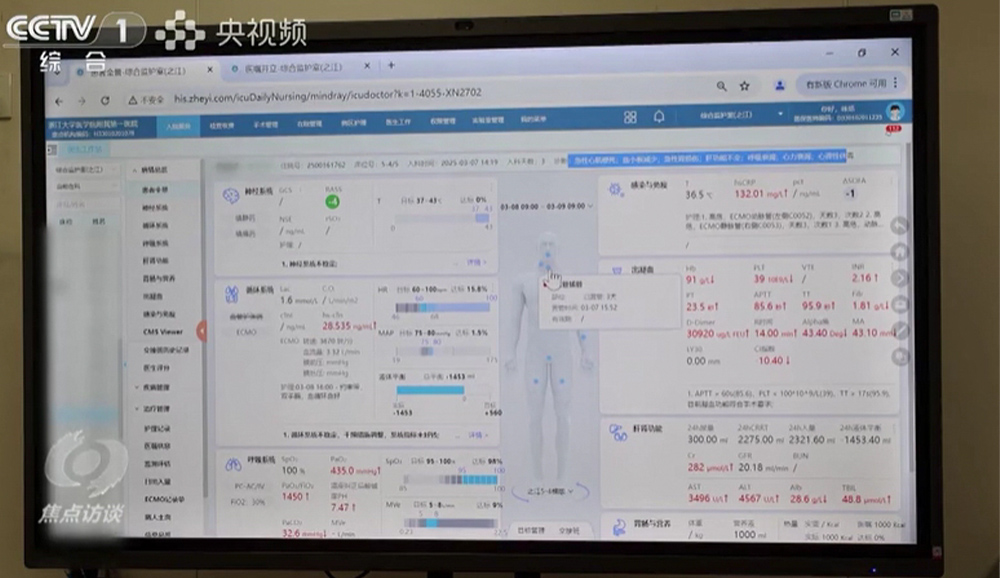
The M-Connect Critical Care Decision Support System brings together data from medical devices, hospital systems, and clinical assessments. Through the lens of critical care medicine, it synthesizes seven major physiological systems to create a digital twin of each patient.
Li Tong
Deputy Director of the Intensive Care Unit, the First Affiliated Hospital, Zhejiang University School of Medicine
It takes more than a general physician to organize all these data into individual dashboards—this level of work requires an ICU specialist.
Director Li Tong uses the Qiyuan Critical Care Model to assess ECMO weaning criteria
Built on the M-Connect Critical Care Decision Support System, the Qiyuan Critical Care Model analyzes a vast amount of data to pinpoint critical decision points. It thinks like a critical care physician, enabling faster and more informed clinical decisions.
Critical care medicine demands extensive teamwork across disciplines. Consider the decision of when to wean a post-cardiac transplant patient from ECMO. That's not a call one team can make alone—it takes cardiac surgeons and intensivists working hand in hand, drawing on relevant clinical assessments. The Qiyuan Critical Care Model can now assist ICU physicians in making sound decisions on such complex issues.
Intelligent Assistant for Critical Care Physicians
Since its deployment at the First Affiliated Hospital of Zhejiang University over six months ago, the Qiyuan Critical Care Model has helped build a high-quality critical care database. It now delivers professional-level clinical support, reducing physicians' workload and allowing faster access to patient data for quicker treatment decisions.
Director Cai Hongliu stated, "We now see AI as an excellent assistant for ICU clinicians. Following the rules we've set, AI helps us monitor patients' conditions around the clock. At the same time, it organizes, refines and analyzes patient data through the lens of critical care medicine. "
As AI continues to advance, it has shown remarkable benefits across a wide range of medical fields and is steadily becoming an indispensable part of modern healthcare.
Liang Tingbo
Party Secretary, the First Affiliated Hospital, Zhejiang University School of Medicine
AI applications in hospitals are expanding rapidly across critical care, pathology, imaging, outpatient clinics, and beyond. On one hand, we need to integrate AI with medicine so that healthcare services become more accessible, effective, and affordable. On the other hand, we need stronger governance around ethics, personal privacy, and data protection as AI continues to advance. AI must develop within regulations that evolve with it.
AI is revolutionizing healthcare by bridging cutting-edge technology with real-world clinical practice. From intelligent diagnosis to precision treatment, it enhances patient care and empowers clinicians with robust tools. The Qiyuan model will also expand from critical care to emergency medicine, anesthesia, imaging, testing, and beyond—making healthcare more efficient and accessible to all.