This blog provides a comprehensive guide to reading a vital signs monitor, covering topics such as:
Accurate vital signs monitoring requires clinicians to understand key parameters — pulse rate, blood pressure, SpO₂, respiration, and temperature — along with their normal ranges and measurement challenges. Misinterpreted alarms and sensor errors contribute to alarm fatigue and delayed clinical responses. Mindray's vital signs monitors feature intuitive interfaces that support accurate data interpretation across diverse care environments.
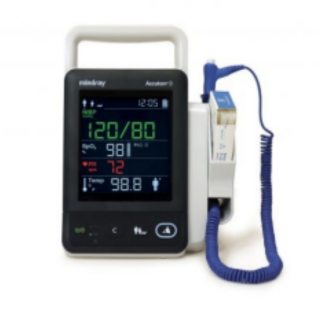
Vital signs monitors are essential devices used by healthcare professionals to evaluate the overall health of a patient. Typically, a vital signs monitor measures a patient’s:
- Blood pressure
- Pulse rate
- Oxygen saturation levels
- Body temperature
- Respiratory rate
Today, vital signs monitors are portable devices with wireless capabilities, enabling clinical teams to quickly and efficiently assess patients in various care settings. They collect a patient’s real-time data, help healthcare professionals identify signs of patient deterioration, and reduce manual errors by automatically sending data to the electronic medical record (EMR). Vital signs monitors are primarily used for spot-check monitoring in routine applications and continuous bedside monitoring when indicated.
The device’s sensors can be gently attached to a patient’s fingers. The sensors deliver information to the monitoring device when connected to a patient. A vital signs monitor operating in continuous mode gives clinicians a full picture of their patient’s health from the time they are set up on the monitor until they are removed from the monitor.
The monitor will send a signal — audible and/or visual alarms — if a patient’s vital signs fall outside healthy levels, indicating the patient may need medical attention. However, sometimes the warning signal could also mean the sensor isn’t getting any information. For instance, the sensor may have detached from the patient.
Spot-check mode monitors, the most commonly used mode for vital signs monitors, periodically monitor a patient’s vital signs. These devices are used to take a single set of vitals from a patient at any given time.
How Clinicians Assess a Patient’s Vital Signs
Exploring the following patient measurements that appear on the monitor is key to learning how to read a hospital monitor accurately.
Blood Pressure
When the heart beats, blood is pushed out of the heart and travels through the body. Blood pressure measures the force applied to the vessels.
When measuring a patient’s blood pressure, clinical teams consider two different numbers — systolic and diastolic.
The top number of the blood pressure reading on a vital signs monitor represents systolic blood pressure, which measures when the heart contracts to pump blood. The bottom number captures diastolic blood pressure, which measures the pressure while the heart is relaxed and the ventricles refill.
The average systolic blood pressure of an adult should measure less than 120 mmHg, and diastolic blood pressure should measure less than 80 mmHg.
Pulse Rate
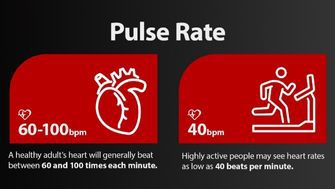
Based on the American Heart Association, a healthy adult's heart will generally beat between 60 and 100 times each minute. Highly active people may see heart rates as low as 40 beats per minute. When learning how to read a heart monitor, pulse rate or heart rate (HR) is the key indicator. The number that indicates this is displayed in the PR box of the vital signs monitor.
Here is a hypothetical example. The pulse rate for a 60-year-old with a heart valve issue should read between 60 and 100 if the patient has been resting in bed. If the patient got up and walked to use the restroom, that number would be larger. Any number higher than 100 displayed on the monitoring device for this particular patient would indicate too much pressure on the arteries for a person with one or more heart valves not functioning correctly.
Oxygen Saturation Levels
Oxygen saturation levels measure oxygen concentration in a patient’s blood on a scale up to 100 (percent saturation). The target range should be between 95 and 100. When doctors measure the oxygen saturation levels in a patient, they read the number on the screen as a percentage. If the number reaches below 90, this indicates that a patient is not receiving enough oxygen. Doctors record the patient’s blood oxygen level in the vital signs monitor’s SpO2 (oxygen saturation) box.
Body Temperature
The average body temperature of a patient can range between 97.8 ° and 99.1° Fahrenheit. The average body temperature is 98.6° Fahrenheit. On a vital signs monitor, the patient’s temperature will display under the section labeled TEMP. For example, if a 40-year-old patient’s body temperature reads 101.1° Fahrenheit in the TEMP box, they have a fever. Body temperature below 95° Fahrenheit indicates hypothermia.
Temperature can vary in a patient based on several factors such as gender, hydration, time of day, and stress. Younger people control body temperature better than older people. Older patients may be ill without displaying signs of a fever. The clinician will consider these factors along with the temperature measurement when determining next steps for the patient.
Respiratory Rate
Respiratory rate measures how many breaths a patient takes each minute. On average, a resting adult's respiration rate typically ranges between 12 and 20 breaths per minute. The patient’s respiration rate is displayed in the RR box of the vital signs monitor. Clinical teams consider a respiratory rate abnormal if it is less than 12 or more than 20 breaths per minute.
Several conditions can change the regular respiratory rate in a patient, including anxiety and heart failure. For example, if the clinician sees above a 20 in the RR section of the vital signs monitor, this may indicate the patient is experiencing distress potentially caused by pain or anxiety.
Overcoming the Common Challenges of Reading Vital Signs Monitors
Several challenges exist when learning how to read a vital signs monitor in hospital settings. These include parameter-specific examples like:
- SpO2: Patient movement can easily dislodge the sensor, making it incapable of capturing the measurements. Weak circulation at the sensor point as well as the presence of nail polish or artificial nails can interfere with readings
- Blood pressure: Correct cuff sizing, patient positioning, and limited patient movement during measurement all impact blood pressure readings
- Temperature: Probe placement and proper contact are essential for temperature capture. Recent intake of hot or cold foods or beverages may also contribute to readings out of the normal range
Additionally, learning how to read a hospital monitor often includes these scenarios:
- Simultaneous multiple alarms
- Sudden parameter changes
- Display visibility in different lighting conditions
- Navigating the screen during patient care
- Clinical teams' ability to distinguish between technical versus clinical issues
To overcome these challenges, we recommend:
- Developing a quick troubleshooting checklist to guide clinicians
- Repositioning sensors when necessary
- Establishing clear documentation requirements and escalation protocols

Mindray is one of the nation's top three developers of healthcare technology and is trusted by over 30 of the nation's leading hospital systems. We leverage decades of industry experience and expertise to deliver on our mission — advance medical technologies to make healthcare more accessible. Our vital signs monitoring solutions empower clinical teams to standardize their monitoring protocols while helping uphold efficiency and the delivery of quality care. Each solution features an intuitive interface to simplify operation and streamline user experiences.
We remain committed to being your long-term partner, with responsive service at every step, from selection to implementation and beyond. With a 97% customer satisfaction rating, the Mindray CARE Team is here for ongoing support throughout your technology's life cycle.
The Significance of the Vital Signs Monitor
Vital signs monitors are essential for clinical teams to oversee a patient's general physical well-being. These measurements provide medical professionals with clues to potential health issues and help them track a patient’s progress toward recovery. The primary function of a vital signs monitor is to alert medical staff when a patient’s vitals move out of established, safe levels. For this reason, vital signs machines are valuable medical devices that help doctors save people’s lives.
If you are looking to purchase a vital signs monitor, explore our solutions to learn more about the vital signs monitors Mindray North America offers or contact us at 551-303-7825.